
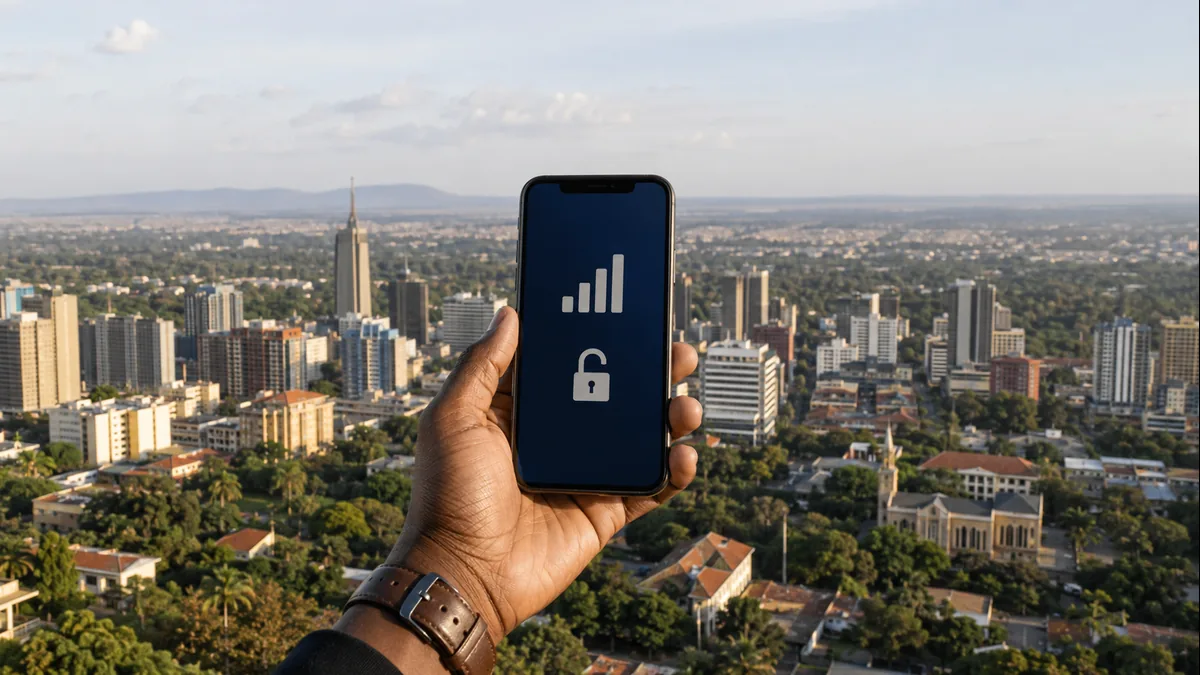
Conditions differ among Africa’s 54 countries and can change. Use this guide as a planning framework, then verify rules for the exact destination, route and date.
Mobile coverage across Africa
Coverage is often strongest in capitals, major towns and transport corridors. It can fall sharply in national parks, deserts, mountains, islands and rural communities. Check the operator’s current coverage map for the exact route rather than assuming countrywide service.
Download tickets, maps, hotel directions and emergency details before leaving a connected area.
Buying a local SIM card
Many countries require passport registration. Buy from an official operator shop or authorised airport kiosk, confirm that activation is complete and test data before leaving. Ask how bundles expire, how to check balance and which top-up methods accept foreign cards.
Keep the SIM holder and registration receipt. Avoid sellers who bypass identity rules or cannot explain the tariff.
Using an eSIM
First confirm that the phone is unlocked and supports eSIM. Compare single-country and regional plans, network partners, data allowance, validity and tethering. Many travel eSIMs are data-only, so ordinary voice calls and SMS may be unavailable.
Install the profile on reliable Wi-Fi before departure, but follow the provider’s instruction on when to activate it.
Roaming, Wi-Fi and security
International roaming is convenient but may include daily fees, fair-use limits, incoming-call charges and expensive out-of-bundle data. Hotel Wi-Fi quality varies and remote lodges may depend on satellite links or generators.
Treat shared networks cautiously: update devices, use encrypted websites, avoid sensitive transactions on unknown networks and consider a reputable VPN.
Mobile money, charging and offline tools
Mobile money is central to payments in parts of East, West and Central Africa, but access rules are not uniform. A local SIM, registration, transaction limits and cash-in points may apply.
Carry the correct plug adapter and a compliant power bank. Prepare offline maps, translation files, booking screenshots, emergency numbers and vehicle charging cables.
Planning comparison
| Option | Best use | Limit to check |
|---|---|---|
| Local SIM | Longer stay in one country | Registration, coverage and bundle expiry |
| Travel eSIM | Fast setup or multi-country data | Device support, partner network, voice/SMS |
| Home-network roaming | Short or business trip | Daily fee, cap and fair use |
| Hotel Wi-Fi | Light use at accommodation | Speed, security and power reliability |
Related Africa travel guides
Official sources and further information
For binding or time-sensitive information, consult the exact destination’s official authorities:
- National immigration authority or foreign ministry for entry and legal rules
- National tourism authority for licensed services and visitor information
- National meteorological service for current weather and seasonal hazards
- Ministry of health or recognised public-health authority for health requirements
- Your embassy or consulate for destination-specific travel advice
Frequently asked questions
Will one SIM work throughout Africa?
No. Coverage, roaming and registration vary by country and operator.
Is an eSIM always better?
It is convenient, but local SIMs may offer better local coverage, voice service or value.
What should I save offline?
Maps, tickets, accommodation directions, insurance details and emergency contacts.
Private-service disclosure: AfricaTourVisa provides private travel and visa support. It is not an embassy or government authority. Eligibility, government fees and entry decisions remain with the relevant national authority.